Opportunity for Pharmacies in Connecticut's $938.4 Million RHT (Rural Health Transformation) Program
MedMe Team
January 26, 2026
A look into Connecticut's $938.4 million RHT program from the pharmacy perspective.
Connecticut's Rural Health Transformation (RHT) Program allocates $938.4 million over five years to rural healthcare providers, including pharmacies. With 9% of Connecticut's population living in rural areas across seven of nine planning regions, this represents an unprecedented pharmacy expansion funding opportunity.
The catch? You need clinical documentation, medical billing infrastructure, and data reporting capabilities. Traditional pharmacy systems can't do this.
This is where MedMe Health becomes essential. Our pharmacy-first EMR sits on top of your existing PMS and enables the clinical documentation, medical billing, telehealth, and reporting required to win RHT grants.
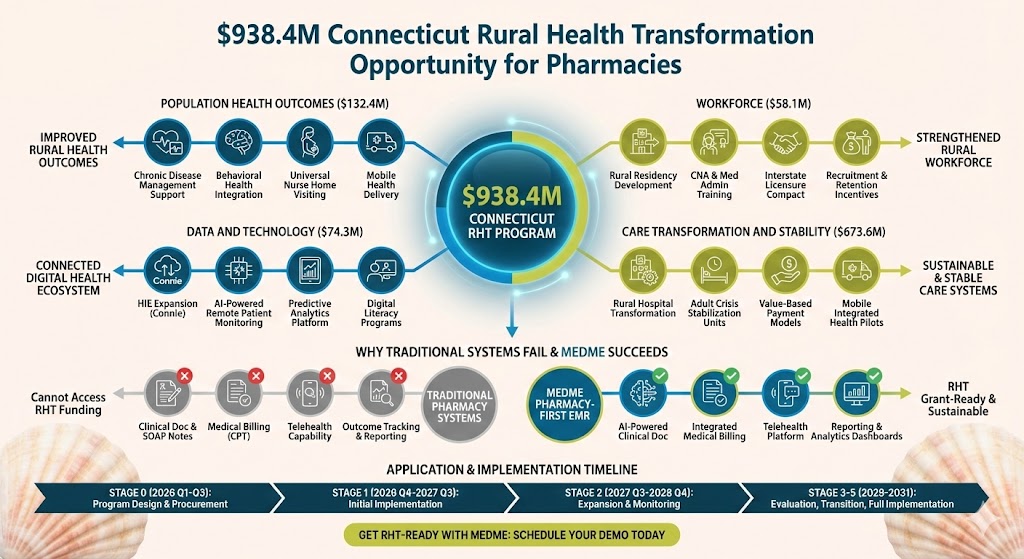
The $938.4M Opportunity: Four Strategic Initiatives
Connecticut's RHT funding is structured across four interconnected initiatives, each targeting critical gaps in rural healthcare delivery.
1. Population Health Outcomes ($132.4M)
Preventive and primary care access expansion
Behavioral health integration in primary care and community settings
Universal nurse home visiting for maternal health
Mobile health delivery (primary care and dental vans)
Chronic disease management support
Evidence-based wellness programs
2. Workforce ($58.1M)
Rural residency program development
CNA and medication administration training standardization
Interstate licensure compact implementation
Rural provider recruitment and retention incentives
Salary supplements for non-licensed healthcare workers
Area Health Education Center (AHEC) expansion
3. Data and Technology ($74.3M)
Health Information Exchange (HIE) expansion
Predictive analytics and care coordination platform
Shared IT infrastructure and telehealth innovation
AI-powered remote patient monitoring
Statewide bed capacity tracking system
Digital literacy programs for rural residents
4. Care Transformation and Stability ($673.6M)
Rural hospital transformation and right-sizing program
Adult 23-hour crisis stabilization units
Value-based payment model development
Mobile Integrated Health (MIH) pilot programs
Program of All-Inclusive Care for the Elderly (PACE)
Regional collaboratives for care coordination
Why Traditional Pharmacy Systems Fail for RHT
Your current PMS (QS/1, Pioneer, Liberty, McKesson) handles dispensing but lacks:
✗ Clinical documentation for patient encounters
✗ SOAP note templates
✗ Medical billing with CPT codes
✗ Telehealth capability
✗ Clinical outcome tracking
✗ Patient appointment scheduling
✗ Grant-required reporting
Without these, you cannot access RHT funding.
The MedMe Solution: Pharmacy EMR Built for RHT
MedMe Health is a pharmacy-first EMR that sits on top of your existing PMS, integrates bidirectionally, and provides everything needed for RHT grants.
✓ Clinical Documentation & Notes
What Grant Reviewers Need:Proof you're delivering clinical services with proper documentation, not just dispensing records.
What MedMe Provides:
Structured clinical templates for every RHT-funded service:
Reduces documentation time by 80% (30 min → 5 min per patient)
Eliminates the documentation burden that kills most clinical programs
Audit-ready records:
Complete audit trails
Electronic signatures
HIPAA-compliant security
Grant compliance built-in
Result: Document 50+ patient encounters per week without overwhelming your pharmacist.
✓ Medical Billing & Claims
What Grant Reviewers Need:Proof your services will be financially sustainable after grant funding ends—aligned with Connecticut's emphasis on value-based payment models.
What MedMe Provides:
Integrated medical billing platform that submits claims directly from clinical documentation
Built-in AI that suggests appropriate billing codes based on documented services:
MTM services (CPT 99605, 99606, 99607)
Chronic care management (CPT 99490, 99439)
Immunization administration (CPT 90471-90474)
Behavioral health screening codes
Transitional care management (CPT 99495, 99496)
Revenue cycle management:
Track claim status (submitted, paid, denied)
Separate medical billing dashboard from Rx revenue
Payment posting and reconciliation
Eligibility verification before services
Denials Management:
Monitor your denied claims and handle them for you
Resubmits the claim and fills the missing requirements
Credentialing support
Contracting assistance
Result: Your clinical services generate revenue from day one, proving sustainability in grant applications and supporting Connecticut's value-based care transition.
✓ Patient Record Management
What Grant Reviewers Need:Centralized patient health records showing comprehensive care—not just dispensing history.
What MedMe Provides:
Centralized clinical patient record within the pharmacy EMR
Bidirectional sync with your PMS - medication history automatically updated
Comprehensive patient profiles:
Medication lists (synced from PMS)
Clinical visit history
Documentation of all clinical encounters
Immunization records
Service history tracking
Result: Demonstrate comprehensive patient management to grant reviewers.
✓ Online Scheduling
What Grant Reviewers Need:Patient access to services with minimal barriers—critical in Connecticut's rural areas where 28.5% of residents delay needed care.
What MedMe Provides:
Patients book appointments online for any clinical service (MTM, immunizations, chronic disease visits, medication counseling)
Appointments automatically appear in your EMR workflows
Multi-service booking - patients schedule flu shot + BP check + medication review in one visit
Group booking - families schedule together (multiple flu shots, for example)
Automated notifications via SMS and email
Seamless scheduling management - cancellations and rescheduling handled automatically
Result: 3x more patient bookings with zero additional staff time for phone scheduling.
✓ Patient Engagement
What Grant Reviewers Need:Evidence of patient follow-up and ongoing engagement—supporting Connecticut's emphasis on prevention and chronic disease management.
What MedMe Provides:
Automated appointment reminders (SMS/email) reduce no-shows by 40%
Streamlined intake - collect patient information and consent digitally before appointments
Pre-visit forms sent automatically
Post-visit follow-ups - care plans, medication instructions, next appointments
All connected to patient EMR record for continuity
Result: Better patient outcomes with less manual staff work.
✓ Telehealth Platform
What Grant Reviewers Need:Capability to serve rural Connecticut patients remotely—critical for addressing the median 32-minute drive time to trauma centers.
What MedMe Provides:
Integrated telehealth within the EMR (no separate platform needed)
Conduct virtual medication therapy management
Remote chronic disease consultations
Virtual immunization counseling and follow-up
Post-discharge medication reconciliation via telehealth
Documentation captured directly in EMR during telehealth visit
Result: Serve patients across Connecticut's rural regions without requiring them to travel extended distances. This directly addresses RHT's access barrier priorities.
✓ Reporting & Analytics
What Grant Reviewers Need:Quarterly reporting on clinical outcomes, patient volumes, and financial performance—demonstrating measurable interventions.
What MedMe Provides:
Built-in reporting dashboards track all grant-required metrics:
Access metrics: patients served, encounters delivered, services by type
Geographic reach: planning regions served, patient demographics
Financial performance: revenue by service type, billing collection rates
Service delivery: documentation of care provided across clinical programs
One-click report generation for quarterly grant submissions
Visual dashboards with charts and graphs
Real-time data - no waiting for month-end spreadsheets
Result: Grant compliance reporting takes minutes instead of hours.
✓ Built-in AI Tools - The Game-Changer
While clinical judgment always remains with the pharmacist, AI automates manual and redundant work—aligned with Connecticut's technology innovation goals.
What Makes MedMe Different:AI doesn't just assist, it transforms how fast you can deliver and document clinical services.
MedMe's AI:
Completes documentation forms automatically
Prepares SOAP notes from structured data entry
Suggests billing codes based on documented activities
Reduces documentation from 30 min to 5 min per patient
Real-World Impact:
Traditional manual: 30 min/patient = 2 patients/hour
With MedMe AI: 5 min/patient = 12 patients/hour
6x more patients served with same pharmacist time
Why This Matters for Grants:
Serve larger patient volumes = higher grant funding
Align with Connecticut's AI-powered care management emphasis
Top 5 RHTP Grant Opportunities for Connecticut Pharmacies
1. Chronic Disease Management Support (Population Health Outcomes)
Services: Team-based chronic condition support for hypertension, diabetes, chronic kidney disease; medication management; care planning; remote monitoring
MedMe Enables:
Clinical templates for chronic disease encounters
AI-generated SOAP notes for each patient interaction
Pharmacist collaboration documentation
Medical billing for chronic care management (CPT 99490, 99439)
Care plan tracking and documentation
Medication management documentation
Grant Size: $75K-$400K
Key Focus: Connecticut's RHT specifically mentions "team-based chronic condition support within primary care for hypertension, diabetes, and chronic kidney disease, including pharmacist and nurse collaboration."
2. Care Coordination and Medication Management (Care Transformation)
Services: Care coordination support, medication reconciliation, post-discharge follow-up, transitional care management
MedMe Enables:
Care coordination documentation and tracking
Transitional care management billing (CPT 99495, 99496)
Financial sustainability through alternative payment models
Grant Size: $100K-$500K
Key Focus: Connecticut's "Improving Primary, Maternal, Behavioral, and Dental Health through Direct Investment and VBP" initiative supports pharmacy participation in value-based care.
4. Mobile Health and Community-Based Services (Population Health Outcomes)
Services: Mobile clinic support, community-based medication services, outreach programming
MedMe Enables:
Clinical documentation for mobile services
Service tracking across multiple locations
Medical billing for community-based encounters
Reporting on geographic reach and service delivery
Integration with mobile health vans
Grant Size: $50K-$250K
Key Focus: Connecticut's mobile clinic pilot includes "at least one of each will serve federally recognized Tribal Nations" and requires robust documentation and reporting systems.
5. Behavioral Health Integration (Population Health Outcomes)
Services: Behavioral health screening, medication adherence for behavioral health medications, collaborative care support
MedMe Enables:
Behavioral health screening tools documentation
Medication therapy management for behavioral health medications
Collaborative care workflow documentation
Medical billing for behavioral health services
Referral tracking and warm handoff documentation
Grant Size: $75K-$400K
Key Focus: Connecticut's "Behavioral health integration in primary care and community settings" initiative emphasizes collaborative care workflows and integration.
Eligibility: Can Your Pharmacy Qualify?
✓ Geographic Requirement
Must operate in one of Connecticut's rural or partially rural planning regions:
Partially rural: Capitol Region, Connecticut Metro, Lower Connecticut River Valley, Naugatuck Valley, South Central Regional, Southeastern Connecticut, Western Connecticut
✓ Clinical Capacity (This Is Where MedMe Is Critical)
You need to demonstrate:
Clinical documentation capability → MedMe's EMR with AI
Medical billing infrastructure → MedMe's integrated billing
Data reporting for outcomes → MedMe's analytics dashboards
Clinical pharmacy services expand preventive care access
Telehealth reduces transportation barriers
Chronic disease management focus
2. Workforce Development:
Efficient documentation reduces pharmacist burden
AI tools attract and retain pharmacists
Support for expanded scope of practice
3. Tech Innovation:
AI-powered documentation and billing
Consumer-facing technology (online scheduling)
Platform ready for HIE integration
Support for predictive analytics integration
4. Sustainable Access & Innovative Care:
Medical billing creates financial sustainability
Value-based care arrangement capability
Care coordination documentation
Support for alternative payment models
Financial Stability Context
Connecticut's rural hospitals face severe financial challenges:
Average operating margin: -14.6% (vs. statewide -0.5%)
$271 million in uncompensated care costs statewide
Public payers account for 10 percentage points more revenue than state average
Pharmacies can help: Clinical pharmacy services reduce avoidable hospitalizations, support chronic disease management, and provide revenue-generating alternatives to hospital-based care.
Integration with State Infrastructure
Connie (State HIE): MedMe's platform architecture supports future HIE connectivity
All-Payer Claims Database: MedMe's reporting exports data in formats compatible with state analytics
AHEAD Model Participation: MedMe's value-based care documentation supports hospital AHEAD participation
Regional Collaboratives: MedMe's reporting enables participation in coordination frameworks
Geographic Challenges Addressed
Connecticut's rural access barriers:
Median drive times: 32 min to trauma centers, 26 min to stroke centers, 24 min to maternity wards
Limited public transportation: Constrained access routes in rural areas
28.5% delay care: Rural residents delay needed medical care due to access barriers
MedMe's Solution: Telehealth eliminates travel, online scheduling reduces coordination barriers, and clinical pharmacy services bring care closer to home.
Grant Application Strengths with MedMe
Demonstrable Readiness
Working systems, not just plans: Live EMR with pilot data
Measurable outcomes: Real patient encounter data
Technology infrastructure: Software capability already in place
Financial sustainability: Active medical billing and revenue generation
Alignment with Four Initiatives
Population Health Outcomes:
Clinical documentation for chronic disease management
Patient engagement tools for follow-up and adherence
Telehealth for expanded access
Workforce:
AI reduces documentation burden
Efficient workflows support retention
Modern tools attract pharmacists
Data and Technology:
Platform architecture supports HIE connectivity
Reporting capabilities for predictive analytics
Consumer-facing digital tools (online scheduling)
Care Transformation and Stability:
Medical billing supporting value-based care
Care coordination documentation
Financial sustainability pathway through alternative payment models
Compliance with Policy Actions
Connecticut is pursuing several policy actions that MedMe supports:
Nutrition CME: Pharmacists can document nutrition counseling
Scope of practice expansion: Documentation supports expanded pharmacist roles
Certificate of Need reform: Financial data supports service line decisions
Regional Planning Integration
Connecticut's RHT includes two regional collaboratives (Northwest and Northeast). MedMe enables pharmacy participation through:
Standardized reporting: Consistent data format for regional analysis
Care coordination tracking: Documentation of collaborative activities
Service delivery documentation: Evidence of pharmacy contributions to regional goals
Outcome measurement: Performance data for regional benchmarking
Conclusion
Connecticut's $938.4M Rural Health Transformation Program is a once-in-a-generation opportunity for rural pharmacies. But accessing these funds requires operational capabilities that traditional pharmacy systems cannot provide.
MedMe Health's pharmacy-first EMR was purpose-built for this moment:
Clinical documentation with AI automation
Medical billing supporting value-based care transition
Telehealth reducing Connecticut's severe access barriers
Reporting for grant compliance and measurable outcomes
Technology infrastructure supporting state data initiatives
Care coordination documentation for collaborative models
The pharmacies that secure RHTP funding will be those that demonstrate readiness on day one. MedMe makes you grant-ready in two weeks.
Connecticut's RHT Plan moves through structured stages over five years. The window to prepare is now—before Stage 0 procurement begins in Q1 2026.
Connecticut Department of Social Services (Lead Agency): https://portal.ct.gov/dss
Connecticut Office of Health Strategy: https://portal.ct.gov/ohs
Connecticut Office of Rural Health: https://www.ruralhealthct.org/
Connecticut's Statewide HIE (Connie): Managed by OHS
Ready to become RHTP-ready? Connecticut's rural communities need your clinical pharmacy services. MedMe gives you the infrastructure to deliver them, the technology innovation Connecticut prioritizes, and the tools to secure funding. With $938.4M at stake and a structured implementation timeline beginning in 2026, now is the time to prepare.


.svg)


